

Who owns what
There is no hosted control plane in the middle. A universe does not call home, and nothing
about running it depends on our availability.
Authentication
Authentication is always on. There is no deployment mode that turns it off, because canvas and studio sign in against it. The gate is default-deny and lives in the application, at the single public listener. Tokens are verified against your provider’s published keys, checking both issuer and audience. A request that does not present a valid one is refused before anything executes. Because the check is in the application, no proxy is ever load bearing for security. A misconfigured load balancer is an availability problem, not an authentication bypass. Letting anonymous visitors reach a workflow is possible, and the decision is made per trigger. Those callers arrive with a synthetic guest identity that carries no roles, so they fail every role requirement naturally.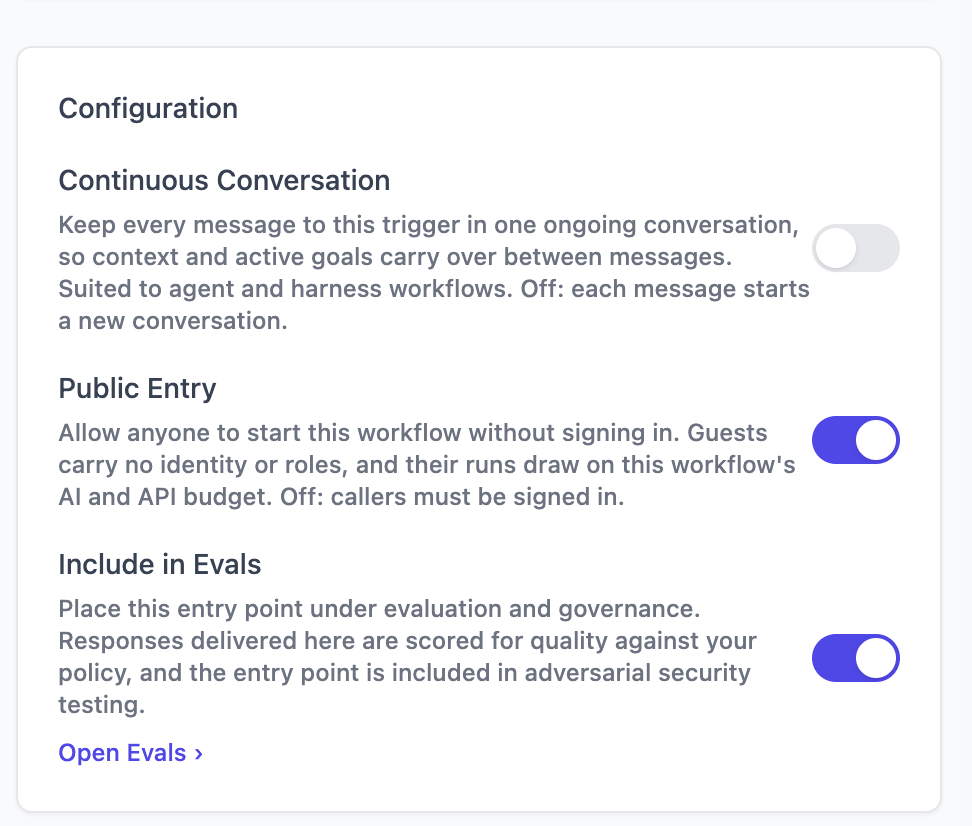
Public entry is a toggle on the trigger, off by default. A guest's runs spend your AI and API budget, so the toggle names that before you turn it on.
Authorization
Two levels. A person holds roles. A role grants permissions. The platform gates on permissions.
An author builds. They open canvas, create and delete workflows, write to spatial,
manage nodes, and publish assets into the universe. An admin does all of that and holds the
secrets as well: the credential store, and other people’s memory.
The difference between the two roles is exactly that. An author can build anything on the
platform and cannot read an API key. Grant the role in your identity provider and the
platform follows it.
An end user holds neither role. They sign in, chat, and run workflows. Nothing else opens
to them.
Every route declares what it needs, in one table. The table names each route beside its
requirement. One function reads it before any handler runs. A route missing from the table is
refused, and the build fails until somebody adds it. Access cannot be left undecided by
accident.
How each ground provides it. With
byo-oidc the provider already models both levels. An
Auth0 tenant has roles containing permissions, and Terraform touches none of it. Cognito has
one level, groups, so the AWS ground holds the role-to-permission map. A pre-token Lambda
applies it, so your Cognito groups are the roles and the Lambda expands them into the
permissions claim.
Flattening the two is a real failure mode. A pool built from permission-shaped groups gives
an administrator every permission and no role. canvas checks the role before it renders,
so the person is refused by the surface they own.
Identity comes from the token, never from the request. A client sends a user id with
every chat message, for routing replies. The server takes the subject from the verified token
instead. A caller cannot run as somebody else, write into their memory, or subscribe to their
conversation.
Every node states who may run it, and the block is compulsory. A reviewer can tell a node
that was considered and left open from a node nobody thought about.
A node can demand a signed-in caller, or a specific claim. The person building the workflow
can demand more on top. Neither can loosen the other. A node that reaches the executor with
nothing declared is treated as requiring authentication.
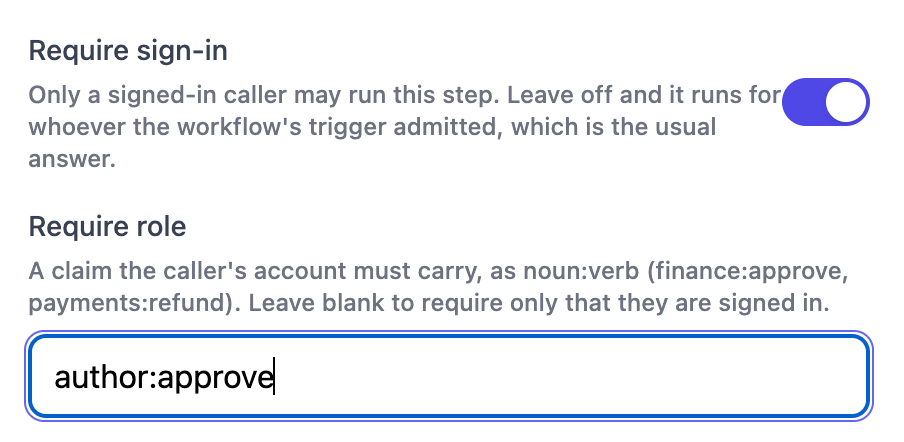
Per step, on the canvas. The claim is yours to name: the platform never invents finance:approve, and your identity provider decides who carries it.
Credentials
A secret is write-only. You type it once. Nothing reads it back, including the screen you typed it into. Editing a credential shows dots and leaves the stored value untouched unless you type a new one. Credential values are encrypted at rest, per field. Every field is encrypted unless it is declared public, so a new credential type cannot leak a key by omission. A region or an account id can be declared public; a key cannot. Values are decrypted at the moment a node runs, and handed to that node alone. A node receives only the credentials it declared. Two nodes in one workflow cannot read each other’s keys, whatever either of them writes, because credentials are addressed by name rather than discovered. The store is admin-only. Reading and writing it needscredentials:manage, which the author
role does not grant.
Nothing an author writes ever contains a value. The manifest names the credential. The value
is entered once in canvas and lives only in the database.
What a node is allowed to do
A node is YAML interpreted by the platform, not code the platform runs on its behalf. Two controls bound it. Declared hosts. Every host a node may call is declared in its package. The list is deny-by-default and HTTPS-only, and it is checked twice: when the package is linted, and again at run time after the URL has been built. A node cannot construct its way to an undeclared destination. A content hash. A node’s composed definition, including its host list, is hashed. The hash is checked when the definition is loaded, so a definition that changed after it was accepted does not quietly run. Publishing a node reaches a universe as pending rather than live. Whoever runs that universe sees the hosts it wants to call, the credentials it needs and the access it demands, and accepts it before it can run. After that first acceptance, iteration is not gated. A node that reaches for something new pauses again.Network posture
Only 443 is open to the internet. SSH, canvas and the log viewer are restricted to an address you nominate, and the builder surface binds to loopback so it is not routable at all. Firewall rules live in the cloud provider rather than on the VM, which removes the class of problem where a container runtime writes its own rules underneath a host firewall. Outbound, a universe needs the container registry, the npm registry, your identity provider and your AI providers. Each provider’s Terraform states them, and Networking explains what breaks if one is blocked.Secrets and rotation
Every deployment generates its own secrets. Database and Redis passwords are random per universe, and so is the credential encryption key. None of them is shared between deployments and none of them is known to us. Secrets are entered per environment. They are never copied from one environment to another, which is covered in Environments.Auditability
Agent activity is recorded, including the content that produced each decision, so behaviour can be reconstructed after the fact rather than inferred. Small deployments ship with a log viewer, restricted to your operator address. Larger ones turn it off and point the container logging driver at whatever you already run, whether that is Splunk, ELK or Datadog.Still open
Two items are honest gaps rather than controls. Both are known and tracked. There is no rate limit and no spend cap. Any signed-in caller can run workflows, and workflows spend money with your AI providers. Nothing in the platform slows a caller down or stops them. Set spend limits at the provider until this lands, because a provider limit holds even if the platform does not. One connection carries its token in the query string. That is why load balancer access logs are switched off in the entry point requirements. Moving the token to a header lifts both the gap and the restriction. The credential encryption key no longer has a fallback default. A universe refuses to start without a real key, so a deployment cannot silently run on a published one.Next: Environments and Promotion